
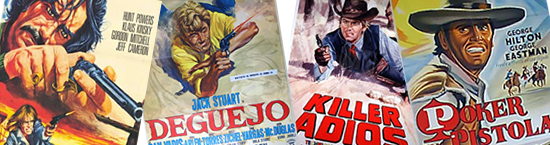
In this twelfth edition of Spaghetti Sunday, the career of George Hilton will be under the microscope, with various of his spaghetti western based flicks being reviewed. It’s important to note that this post will continue to grow over time, with new George Hilton reviews added as more of his spaghetti western flicks are watched. As with every article and review on the website, this entire series will be spoiler-free.
– The George Hilton Edition –
Jorge Hill Acosta Lara, better known to audiences as George Hilton, was born on July 16, 1934, in Montevideo, Uruguay. He began his career working in radio before moving to Argentina in 1955 to pursue acting, where he soon appeared in several popular soap operas. In 1963, attracted by Italy’s thriving film industry, Hilton relocated once again to further his career.
His journey into the spaghetti western genre began under the direction of Lucio Fulci with Massacre Time (1966), in which he starred alongside Franco Nero. Although cast in a supporting role, his performance quickly established him as one of the genre’s most recognisable stars.
As his career entered its twilight during the 1990s, Hilton appeared primarily in television productions. Although he gradually reduced his screen appearances in later years, he remained active and is still fondly remembered as one of the greatest stars of Italian cinema.
It’s worth noting that George Hilton died in Rome, Italy on July 28, 2019, at the age of 85.
Last of the Badmen – 1967
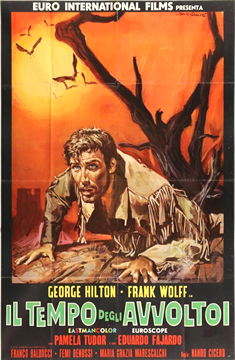
Directed by Nando Cicero and released in 1967, Last of the Badmen sees George Hilton star as Kitosch, a man wrongly accused of a crime he did not commit. As a result, he is forced to team up with the outlaw Joshua Tracy (Frank Wolff), with the pair encountering a series of testing challenges across the modest ninety-five minute runtime. A notably unique spaghetti western in terms of both story and character presentation, with the picture featuring one of the most ruthless and sinister figures within the genre.
One aspect of Last of the Badmen that manages to stand out is its impressive cast, with several notably strong performances across the board. As stated, George Hilton adopts the role of Kitosch, but Frank Wilff, who appears as the ruthless outlaw Joshua Tracy, steals much of the show, with the filmmakers showcasing his character slowly decaying into apparent madness. Elsewhere, Eduardo Fajardo provides support, as well as Femi Benussi and Cristina Iosani.
All in all, Last of the Badmen is a more than acceptable entry into the genre. It should be noted, however, that some of the more action-driven scenes stray well beyond the bounds of realism, as is often expected within the genre, though some viewers may find the more implausible outcomes a little difficult to overlook. This is undoubtedly a film where suspension of disbelief is required.
Sartana’s Here… Trade Your Pistol for a Coffin – 1970
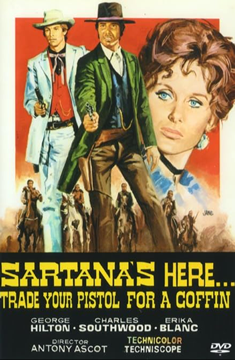
Directed by Giuliano Carnimeo, Sartana’s Here… Trade Your Pistol for a Coffin centers around the character of Sartana (George Hilton), who witnesses the robbery of a large shipment of mine gold by a gang of Mexican bandits, only to discover that the loot was, in fact, nothing more than bags of sand. Setting out to solve the mystery, he soon finds himself joined by a variety of interested and distinctive parties, including the charismatic, yet equally dangerous, Sabath (Charles Southwood). A very impressive addition to the spaghetti western genre, featuring a broad and standout cast.
Not only does Sartana’s Here… Trade Your Pistol for a Coffin feature a solid cast, but it also boasts some impressive dialogue, an engaging story and noteworthy production design throughout its ninety-three minute runtime. With that said, the picture certainly falls into the category of starting far stronger than it finishes, with the latter stages becoming a little bloated and convoluted at times, while one or two scenes seem to overstay their welcome as the film rolls on.
All in all, however, Sartana’s Here… Trade Your Pistol for a Coffin is a thoroughly enjoyable flick that I’d firmly recommend to fans of the genre, featuring an ample amount of action, light humour, suspense, and plenty of memorable characters to keep audiences entertained throughout.
It’s worth noting that the website also includes a short review of Poker with Pistols (1967) that was published recently, featured in the article Spaghetti Sunday – Edition #9, which stars George Hilton.

