
In this sixth edition of Western Wednesday, the career of Peter Lee Lawrence will be celebrated, with various of his spaghetti western based flicks being reviewed. It’s important to note that this post will continue to grow over time, with new Peter Lee Lawrence reviews added as more of his spaghetti western based films are watched. As with every article and review on the website, this entire series will be spoiler-free.

The Peter Lee Lawrence Edition
Karl-Otto Hyrenbach, better known to many as Peter Lee Lawrence, was a German actor born in 1944, that enjoyed short-lived fame as a leading man in many spaghetti westerns during the 1960’s and 1970’s. His first notable film role was a small, uncredited, but important appearance as the brother-in-law of Lee Van Cleef in For a Few Dollars More (1965), before going on to star in almost 20 spaghetti westerns.
He was mostly memorable in spaghetti westerns because of his youthful looks and natural energy. Even though he was young, he had a strong presence on screen and looked believable in both quiet, dramatic moments and fast-paced action scenes. His athleticism made the shootouts and stunts feel exciting, and his charm helped him stand out from other actors of the time.
Sadly, in 1972, Lawrence began suffering from severe headaches, and despite undergoing surgery, he passed away in April 1974 at the young age of 30. He was married and had a son.
Killer Caliber .32 – 1967
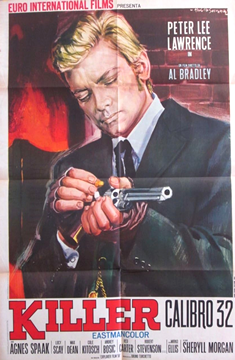
Directed by Alfonso Brescia, Killer Caliber .32 focuses on the story of Silver (Peter Lee Lawrence), a man tasked with hunting down seven members of a masked gang, responsible for the robbery of a stagecoach, as well as murder of its four passengers. Saloon girls and poker games liven this action-packed flick up, with some good humour injected along the way too.
Killer Calibre .32 stands out slightly from many spaghetti westerns of its era, with the filmmakers choosing to build the story around a murder mystery rather than that of wild action. At times, this angle feels a little confusing and stretched, but it does give the film a unique twist. What really keeps the flick engaging, though, are the well-placed bits of slapstick comedy that add unexpected charm. On top of that, the sharp and witty dialogue provides some genuinely funny exchanges between the main characters, giving the film plenty of personality.
With that being said, the slightly muddled murder mystery storyline holds it back from being a spaghetti western I’d recommend to most viewers, aside from dedicated enthusiasts looking to tick this one off their list.
Killer, Adios – 1968

Directed by Primo Zeglio, Killer, Adios (also known as Winchester One of One Thousand), centers around a young man named Jess (Peter Lee Lawrence), who returns to his hometown ten years after the killing of his parents. Upon his return, he is asked by the Sheriff to assist in finding out who is responsible for the random act of killing people, with the only clue being a rare Winchester rifle.
First off, it must be said that Killer, Adios shares some striking similarities with that of Killer Calibre .32, released just a year earlier and reviewed above. Both pictures lean very heavily into the murder mystery aspect of story-telling, but unfortunately, Killer, Adios can feel a little too convoluted at times for its own good, especially in the latter half of the movie. With that being said, the real highlight lies in the film’s slick and stylish costume and set design, with Peter Lee Lawrence himself easily standing out as one of the most fashionable leading men of the spaghetti western era, as well as Marisa Solinas, who adopted the role of Sheila.
All in all, Killer, Adios features some extremely easy on the eye visuals and if you’re sustainable to a murder mystery spaghetti western, then this is probably one you’ll enjoy, aside from that, I more than likely wouldn’t recommend this to most viewers.
Pistol for a Hundred Coffins – 1968
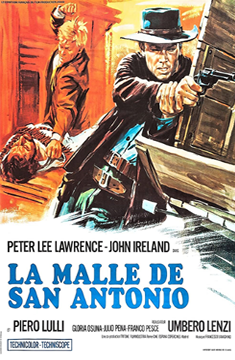
Directed by Umberto Lenzi, Pistol for a Hundred Coffins revolves around Jim Slade (Peter Lee Lawrence), a soldier, returning from the civil war only to discover his parents murdered at their home. Word gets round that the gang led by Corbett (Piero Lulli) have committed the crime, so Jim seeks his revenge. With lots of interesting twists and turns along the way, Pistol for a Hundred Coffins may be up there as one of Peter Lee Lawrence’s strongest performances.
As mentioned, Peter Lee Lawrence delivers a particularly strong performance, as does John Ireland in the role of Douglas. Their characters help make the film engaging and entertaining, with the filmmakers also introducing one or two intriguing subplots along the way to maintain viewer interest, some were somewhat unique for a spaghetti western, too. A small criticism, however, would have to be the sheer number of double-crosses that emerge toward the closing stages of the picture, which ultimately felt somewhat convoluted and messy in nature.
That said, I’d strongly recommend Pistol for a Hundred Coffins, as it manages to convey some unique attributes and present an easy to follow, simplistic story throughout the modest eighty-three minute runtime.
 The DC Review Blog - EST. 2020