
In this fifth edition of Western Wednesday, the career of Robert Woods will be under the microscope, with various of his spaghetti western based flicks being reviewed. It’s important to note that this post will continue to grow over time, with new Robert Woods reviews added as more of his spaghetti western based films are watched. As with every article and review on the website, this entire series will be spoiler-free.

The Robert Woods Edition
Robert Woods, born July 19, 1936, is an American film and television actor, noted for his extensive work in the spaghetti western genre during the 1960’s and 1970’s. With a natural screen presence, Woods quickly became a familiar face in the genre, often cast as the stoic gunslinger or morally ambiguous antihero that defined the era. His numerous credits include parts in over 50 films, including 42 in which he was top-billed.
It is worth noting that Woods conducted an interview with “The Spaghetti Westerns Podcast” just a few years ago – for anyone who loves the genre, it’s an interview well worth seeking out.
Starblack – 1966
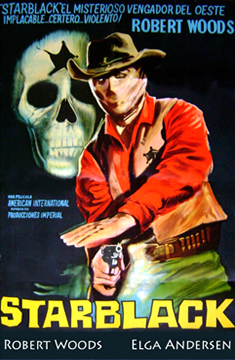
Directed by Giovanni Grimaldi, Starblack – also known as Johnny Colt – was one of the early entries into the spaghetti western genre. The story focuses on a character known as “Starblack,” a mysterious hero who dresses entirely in black, while concealing his true identity. He also carries black stars, which he leaves behind at the scene of his exploits as a symbol of justice.
Starblack does contain a fair number of flaws, most notably its low production values, a storyline that borders on being overly simplistic for the average viewer, and some questionable performances from some of the supporting cast. That said, however, the film’s overall sense of fun ultimately outweighs these shortcomings, with Robert Woods’ performance, in particular, standing out. The flick is also helped by some nicely crafted action sequences throughout the modest ninety-three minute runtime.
Ultimately, if you’re after a simple, easy-to-watch bit of fun, Starblack comes across as a solid choice. It’s very straightforward, free of any form of convolution and successfully embraces a few of the familiar genre clichés in the process.
Black Jack – 1968
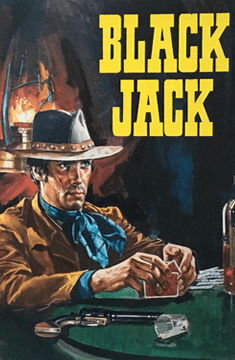
Directed by Gianfranco Baldanello, Black Jack centres around the story of Jack Murphy (Robert Woods), the leader of a gang of bank robbers. Things, however, quickly turn sour, as the gang decide to turn on their leader, leaving him for dead and brutally assaulting his sister. Once recovered, Murphy is hell bent on extracting revenge and goes on a mission to seek justice.
Prior to watching Black Jack, I had heard that this release was widely regarded as one of the finer spaghetti westerns of this era – and that’s certainly a notion I’d agree with. The flick featured an engaging, easy to follow tale of revenge that never really stalled or felt stale. There was also a good amount of action included, as well as some beautiful cinematography captured in the vast Israeli desert.
Overall, Black Jack is a strong and enjoyable spaghetti western. The story moves along well, the desert setting looks great, and Woods gives a solid performance in the lead. Fans of the genre will definitely find this one worth watching.
El Puro – 1969
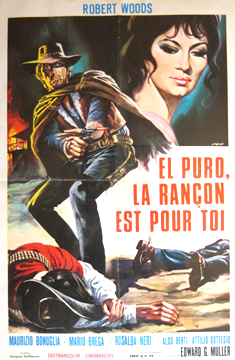
Directed by Edoardo Mulargia, El Puro (also known as The Reward’s Yours… The Man’s Mine), centers around an alcoholic outlaw (Robert Woods) that is being hunted by a group of deplorable bounty hunters for a large reward. It’s worth noting that El Puro is widely considered a divisive film among the spaghetti western community – some holding it in high regard, while others find themselves strongly disliking it.
From a personal perspective, El Puro stands out as one of the stronger entries in the genre, offering stark contrast to the usual action-packed and chaotic natured spaghetti westerns. The filmmakers take a much slower and more methodical approach, with a large majority of the flick unfolding in deserted, almost ghost-like towns that successfully add to the overall mood and atmosphere. The action and gunplay are also kept to a minimum, however, there are still moments of shocking brutality, which may not appeal to everyone.
In conclusion, there’s no denying its uniqueness, and for those open to a slower, less explosive spaghetti western that places greater emphasis on character growth and story development, El Puro is certainly worth giving a shot.
Mallory Must Not Die! – 1971
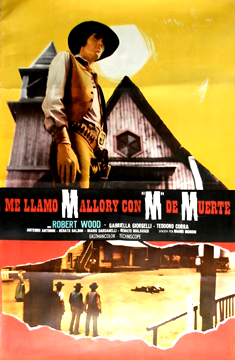
Directed by Mario Moroni, Mallory Must Not Die!, centers around the retired Colonel Harper (Renato Baldini), who wishes to retire to his ranch, but struggles after the malicious Bart Ambler (Teodoro Corra) shows strong interest in the property. Larry Mallory (Robert Woods) is a partner of Harper’s and now the pair have a fight on their hands to keep the various parties at bay. A conflicting submission to the genre, with many critics bemoaning this later release as being well below par.
Mallory Must Not Die! certainly does stray away from the traditional aspects of many spaghetti westerns, instead presenting a slow, basic, and methodical story that focuses largely on character and relationship development, while also injecting a romantic angle too. There seems to be very few moments of action, but when they do appear, they are executed rather well, with the flick also featuring some nice shots of the Italian countryside, capturing multiple large, wide-open fields.
All in all, Mallory Must Not Die! certainly is different, but for most purists, as well as Robert Woods fans, I’d recommend this one.
Kill the Poker Player – 1972
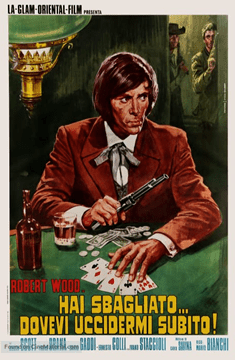
Directed by Mario Bianchi, Kill the Poker Player focuses on the Federal Agent Alan Fields (Robert Woods), who is undercover as Jonathan Pinkerton, an employee of Lloyds of London, a bank that are investigating a robbery where one of the three thieves has killed the others, before taking possession of the money involved.
On the face of it, Kill the Poker Player seemed to have somewhat of a simple and straightforward plot, but sadly the flick came across as a little too convoluted for its own good, with very little action included either. With that being said, the one strength I did happen to notice, came in the form of its mixture of genres that the filmmaker managed to bring to the table. There were strong murder mystery elements, along with certain horror factors too, with the flick even being labelled as a horror on IMDb. Those horror factors stemming largely from the amount of screen-time given to certain reptile creatures – snakes.
Ultimately, Kill the Poker Player (also known as Creeping Death) isn’t a particularly memorable entry in the genre and it’s not one I’d recommend to people, beyond to those dedicated purists that are hoping to complete their collection, or to viewers with a specific interest in murder mystery.
 The DC Review Blog - EST. 2020