In this third edition of Western Wednesday, a selection of Klaus Kinski’s spaghetti western flicks will be reviewed. Renowned for his intense performance style as well as being notorious for his wild personality, he was cast in over one-hundred and thirty movie roles within his career. It’s important to note that this post will continue to grow over time, with new Kinski reviews added as more of his spaghetti western based films are watched. As with every article and review on the website, this entire series will be spoiler-free.
The Klaus Kinski Edition
Klaus Gunter Karl Nakszynski, better known to many as Klaus Kinski, was a German actor born in 1926, boasting a career that spanned across multiple genres, languages, and nationalities. This article, however, will focus solely on one specific genre that Klaus gained infamy within – the spaghetti western genre.
Kinski died on 23 November 1991 of a sudden heart attack at his home in Lagunitas, California. His body was cremated, and his ashes were scattered into the Pacific Ocean.
Before beginning with the reviews, I must note that it would be remiss of me not to touch on the actors controversial and turbulent history, with Kinski being known as being prone to “emotional and often violent outbursts”, while also suffering from a history of mental illness. The German was described by Werner Herzog as “one of the greatest actors of the century, but also a monster and a great pestilence.”
The Great Silence – 1968
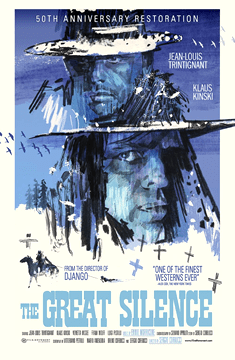
Directed by Sergio Corbucci, The Great Silence is widely considered one of the bleakest and most memorable spaghetti westerns. Set in the snow-covered mountains of Utah, the story follows a mute gunslinger known as Silence (Jean-Louis Trintignant), who is drawn into conflict with a gang of ruthless bounty hunters led by the cold-blooded Loco (Klaus Kinski).
The story is one of the film’s biggest strengths, populated with political undertones of corruption and greed, yet manages to remain easy to follow. It never feels convoluted or confusing, instead drawing you in with good pacing and effective subplots. Added to this are the high production values, cinematography, and a haunting soundtrack that lift it high above many releases of a similar nature.
Decades after its release, the flick still stands up as one of the genre’s most powerful films, complete with a bold and shocking conclusion. It’s worth noting that the website also includes a full length review of The Great Silence (1968) that was published recently.
And God Said to Cain – 1970
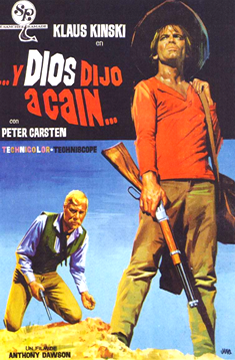
Directed by Antonio Margheriti, And God Said to Cain tells a simple story of revenge, with some rather unique attributes injected too. Released in 1970, Klaus Kinski stars as the lead man, Gary Hamilton, who sets out on a quest to find and eliminate the people responsible for his wrongful sentence of 10 years hard labour. Kinski puts in a great performance in the star role, while Peter Carsten also put in a noteworthy role, portraying Acombar.
Interestingly, the foundations of the flick differed slightly from certain spaghetti westerns of the same era. The entire premise revolved around the action unfolding at sundown, alongside an anticipated tornado that was set to strike the town at the same time. The overall setting and tone of the picture was dark, gothic, and menacing from the first minute until the last, with the soundtrack complementing the atmosphere tremendously.
The pacing was, at times, a little slow, and with a runtime of one hundred minutes, the filmmakers could have trimmed a few of those minutes down. Ultimately, however, And God Said to Cain presents the viewer with a simple, straightforward story that offers a wealth of entertainment.
Coffin Full of Dollars – 1971
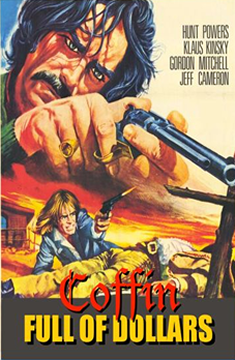
Directed by Demofilo Fidani, Coffin Full of Dollars is an Italian produced spaghetti western with one of the most straight forward storylines you’re ever likely going to stumble upon. The murder of a pair of brothers results in two families, located close to the Mexican border, feuding with each other. Bullets are fired, blood is spilt and buildings are burned in this action packed, relentless western.
With that being said, it’s probably fair to say that the acting and certain aspects of the plot were a little cheesy and overdone at times, especially if you’re watching this for the first time, but if you’re hoping for an authentic spaghetti western, with very few dull moments, then this one won’t leave you disappointed.
On the whole, Coffin Full of Dollars seemed to tick a multitude of boxes when it came to creating an enjoyable low-budget flick – the characters were vast and mostly likeable, with one or two worthy of more screen time than they actually acquired – especially Klaus Kinski, who adopted the role of Hagen. Not one I’d widely recommend, except for fans of the genre.
Black Killer – 1971
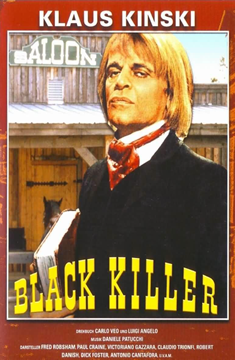
Directed by Carlo Croccolo, Black Killer, released in November 1971, centers around the town of Tombstone, where a newly appointed sheriff vows to rid the streets of outlaws such as the O’Hara brothers. He is aided by a mysterious lawyer, James Webb (Klaus Kinski), a gentle, soft-spoken figure who constantly carries law books and seems to know more than he lets on. As far as spaghetti westerns go, Black Killer boasts many of the genre’s familiar clichés, and it does provide the viewer with far more positives than negatives during its modest eighty-five-minute runtime.
At times, Black Killer feels cheaply made, with a messy and unclear plot that comes across as extremely rushed in stages, with certain scenes seeming to provide humour for all the wrong reasons. Despite this, the flick still holds a strong, yet strange appeal, with its very dark, almost gothic feel, and some very brutal scenes too. For all its flaws, the picture manages to leave a lasting impressing on the viewer.
It’s also worth noting that Fred Robsahm appears alongside Kinski in a supporting role as Burt Collins. In my view, Black Killer is worth watching again and isn’t just a film made only for hardcore genre fans.
 The DC Review Blog - EST. 2020