In this second edition of Western Wednesday, a selection of Lee Van Cleef’s spaghetti western flicks will be reviewed. Van Cleef is one of the most iconic and standout spaghetti western stars of all time. It’s important to note that this post will continue to grow over time, with new Van Cleef reviews added as more of his spaghetti western based films are watched. As with every article and review on the website, this entire series will be spoiler-free.

The Lee Van Cleef Edition
Leroy Van Cleef Jr, better known to many as Lee Van Cleef, was born January 9th, 1925 in Sommerville, New Jersey and received his on-screen debut in High Noon (1952), soon followed by films such as The Tin Star (1957), but it was in the 1960’s when the American born actor was to receive his big break. Sergio Leone decided to cast the actor as a main protagonist alongside Clint Eastwood in For a Few Dollars More (1965) and then The Good, the Bad and the Ugly (1966) just a year later.
After his key roles in Leone’s films, Van Cleef became a major star in the spaghetti western market, playing often central and typically heroic figures in the process. To this day, Van Cleef is widely regarded as one of the staples of the genre.
Van Cleef suffered from long-term heart problems dating back to the 1970s and continued working in film right up until his eventual death on December 16, 1989. He passed away at his home in Oxnard, California, from a heart attack, with throat cancer listed as a secondary cause. Consequently, he was buried at Forest Lawn Memorial Park in Hollywood Hills.
The Big Gundown – 1967
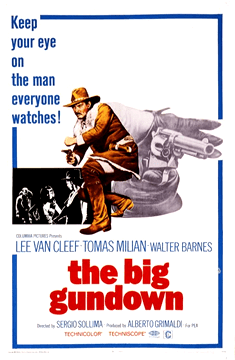
Directed by Sergio Sollima, The Big Gundown, in what would be Lee Van Cleef’s first starring role since his hit success in The Good, the Bad and the Ugly (1966), sees the character, John Corbett (Lee Van Cleef), tasked with tracking down Cuchillo Sanchez (Tomas Milian), a Mexican peasant accused of the rape and murder of a young girl in a small town in Texas. The story was a typical cat and mouse tale with some interesting twists and turns injected along the way, boasting extremely high production value.
It’s fair to say that the first half of the picture had a distinctly American feel to it, with the filmmakers trying to convey an authentic Texan feel, while the second half of the movie seemed to have a heavy Mexican influence. All of this was achieved successfully by the filmmakers, despite the majority of filming actually being filmed in Europe – Spain to be more precise. As well as the easy-on-the-eye cinematography, the soundtrack utilised was also noteworthy.
Interestingly this is publicly noted as being one of Quentin Tarantino’s favourite spaghetti westerns and that’s a notion I’d agree with too. The Big Gundown isn’t just a film that will appeal to fans of the genre, it’s one whose brilliance should be appreciated by film lovers in general as well. Strongly recommended.
Death Rides a Horse – 1967
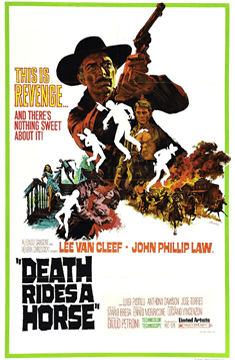
Death Rides a Horse features a story based around a young gunfighter (John Phillip Law) seeking revenge for the brutal murder of his family. The gunfighter joins forces with Lee Van Cleef’s character, an ageing, former outlaw that had previously served time in jail for a crime he did not commit. This was an at times interesting flick, featuring a sensational score by the infamous Ennio Morricone.
Despite delivering a wealth of clichés that you’d come to expect from a spaghetti western (fist fights, deadly shoot outs, poker scenes, moments of comedy, authentic costume design and realistic set design) I can’t help but feel the lengthy runtime hindered the picture, especially as at times it seemed like the plot was somewhat convoluted in nature. If the film had been trimmed by 20-30 minutes and the story had been shortened, this would have come across as a far more effective release.
The finer parts of the movie, however, stemmed largely from the performances of the two main characters portrayed by Lee Van Cleef and John Phillip Law, respectively. For that reason alone, I’d recommend this as being one to watch.
Day of Anger – 1967
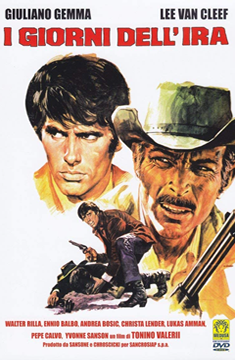
Directed by Tonino Valerii, Day of Anger centres around a scruffy garbage boy called Scott Mary (Giuliano Gemma) who becomes a pupil of the dangerous gunfighter, Frank Talby (Lee Van Cleef), before the balance of power quickly begins to alter as the former gains experience and starts to become aware of his tutors real intentions. An important release in the spaghetti western genre, with many holding Day of Anger in very high regard,
Surprisingly, the film wasn’t packed with nonstop action from start to finish. Instead, its primary focus lay on the characters, their interactions, and the evolution of their relationship over the ninety-minute runtime. The first half unfolded slowly and deliberately, yet never felt dull, while the second half delved deeper into the story, introducing more action alongside moral dilemmas.
For me, the standout strength of Day of Anger was Lee Van Cleef’s strong performance in the lead role, which manages to make the film engaging. That said, the movie also delivers a tense, well-crafted, and highly effective finale which is worth a watch too.
The Grand Duel – 1972
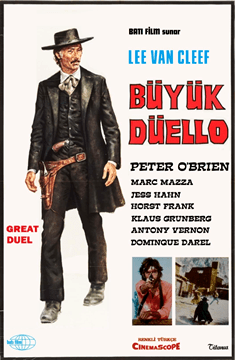
Directed by Giancarlo Santi, The Grand Duel revolves around a hardened former sheriff (Lee Van Cleef), who comes to the aid of Philip Vermeer (Alberto Dentice), a man falsely accused of murder, helping him face down the trio of brothers determined to see him dead. A somewhat polarising release in the genre, but ultimately it’s one I’d recommend – especially to fans of Lee Van Cleef.
Throughout the flick, filmmakers manage to place a strong emphasis on the characters. Van Cleef is cast as the ageing gunfighter, while Alberto Dentice delivers a convincing performance in his support role, which is made even more intriguing by the fact he never appeared in another film after The Grand Duel. The Saxon family also stand out as a highlight, and I found myself wishing they’d been given more screen time and more of a backstory throughout the ninety-eight minute runtime.
All in all, if you’re open to a spaghetti western that offers strong acting performances, distinctive and varied locations, as well as a straightforward story, The Grand Duel is well worth your time.
 The DC Review Blog - EST. 2020
Pingback: High Noon (1952) – Review | The DC Review Blog – EST. 2020